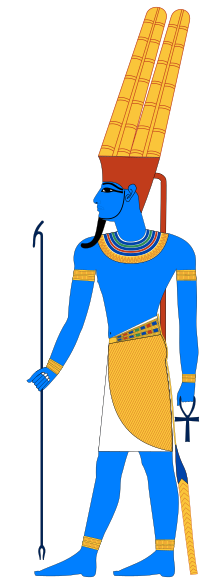
TYPE: Supreme Creator God
ORIGIN: Egyptian
KNOWN PERIOD OF WORSHIP: Probably pre-Dynastic but historically circa 2400 BCE to end of Egyptian period (circa 400 CE)
SYNONYMS: Amun kem-atef (snake god); Amun kamutef (fertility god)
CENTER(S) OF CULT: Thebes (Luxor)—Great Temple of Amun at Karnak; Luxor Temple south of Karnak dedicated to the ithyphallic form of Amun kamutef.
ART REFERENCES: Many portraits on temple walls, etc; reliefs; statues; obelisks including notably that of Queen Hatsheput; stelae.
LITERARY SOURCES: Pyramid Texts from the end of Dynasty V (2494-2345 BCE); temple hymns; the Book of the Dead; the Great Harris Papyrus; many other textual references.
SYMBOL: Two vertical plumes, the ram headed sphinx (Criosphinx)
CONSORT: Amunet, Wosret, Mut
OFFSPRING: Khonsu
GREEK EQUIVALENT: Zeus
INFORMATION: Amun is a sun god, lord of the sky and king of the Egyptian world. He is perceived as a primeval deity present in chaos at the creation of the cosmos and is therefore also one of the eight deities of the Ogdoad coupled with the goddess Amaunet and representing hidden power. He is portrayed as a pharoah, with blue skin and wearing a modius (turban) surmounted by two tall plumes of feathers symbolic of dominance over both Upper and Lower Egypt. In addition to the major temples at Luxor, other sanctuaries were built beyond the first Nile cataract at Amada, Soleb, Gebel Barkal, and Abu Simbel.
Amun is symbolized chiefly by a ram with curved horns. The Nile goose is also sacred to him. He is a god regarded as hidden but spreading throughout the cosmos, unseeen but everywhere. Though depitcted anthropomorphically, in temple hymns other deities describe him as "hidden of aspect, mysterious form." In the New Kingdom, from the middle of the sixteenth century BCE onward, Amun was drawn as a manifestation of the ancient sun god of Heliopolis, which effectively raised his prestige still further and earned him the title "King of the Gods". He was also regarded as bring the father of each pharoah. At Thebes he was revered as a snake deity with attendant connotations of immortality and endless renewal. As a member of the Ogdoad he has the head of a snake.
Amun's ithyphallic form probably came from the notion that because he was "first formed" of the gods, he could not have a father and therefore had to impregnate his own mother. He is generally regarded as a god with great sexual attributes. The Temple of Queen Hatsheput at Deir el-Bahari bears a relief of her mother impregnated by Amun. A similar scene exists in the Temple of Amenhotep III at Luxor. The Great Hall of Hypostyle is filled with wall paintings of Amun and the pharoah, and contains several processions honoring Amun. By the twelfth century BCE the Amun priesthood was a powerful force in Egypt, leading to the eventual contest between Amun and Aten, the god "created" by Amenhotep IV. Amun's eclipse was short-lived and he returned to prominence unitl the end of Egyptian history.